Activity
The activity occurred at
Enfield in
North London, at 284 Green Street[2],
a
council house rented to Peggy Hodgson, a
single parent with four children.[1]
During this time furniture is said to have moved by itself,
knockings on the walls were heard, and children's toys were said to have
been thrown around and to have been too hot to touch when picked up.[3]
A police officer signed an
affidavit to affirm that she saw a chair move.[4]
Reports of the activity attracted various visitors including
mediums and members of the press. One photographer reported being hit
on the forehead with a
Lego brick.[5]
After visiting the house, George Fallows, a senior reporter for the
Daily Mirror, suggested that the
Society for Psychical Research (SPR) be called in to investigate.
Investigations
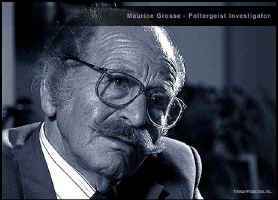
The incidents were duly investigated by
Maurice Grosse and
Guy Lyon Playfair, both members of the SPR, who were convinced by the
evidence which they encountered during their thirteen month
investigation.
The family in the Enfield case consisted of a mother, two daughters
and two sons; Margaret aged 12, a younger sister Janet aged 11, Johnny
aged 10 and Billy aged 7. Billy had a speech impediment. Johnny featured
only marginally in the inexplicable events, at least 26 of which the
investigators considered could not be accounted for by fraud. These
included moving furniture, flying marbles, interference with bedclothes,
cold breezes, pools of water on the floor, apparitions, physical
assaults, graffiti, equipment malfunction and failure, disappearance and
reappearance of objects, apparent levitations, and fires which
spontaneously ignited and extinguished themselves.
Among other alleged phenomena they witnessed was Janet speaking
using her
false vocal folds for hours on end while she was apparently
possessed by another entity. Speaking in this way is believed to be
medically impossible.[citation
needed] When speaking with the false cords Janet
said she was "Bill" who had died in the house of a
brain haemorrhage. The "Bill" persona habitually made jokes and
exhibited a very nasty temper, swearing at Maurice, once calling him a
"fucking old sod". Grosse was contacted by a man who claimed to be
Bill's son. Recordings were made of these occurrences. After the
BBC went to the
house the recording crew found the metal inside of the recording
machines bent, and recordings erased.[6]
Further investigations by Anita Gregory and John Beloff, also from
the SPR, were less positive. They spent a few days with the family and,
after they found them bending spoons themselves,[7]
concluded that the children had faked the poltergeist activity. Janet
admitted to Gregory that they had fabricated some of the occurrences.
This admission was repeated on the
ITV News (12
June 1980) when she stated: "Oh yeah, once or twice [we faked
phenomena], just to see if Mr Grosse and Mr Playfair would catch us. And
they always did."
After writing a feature on supernatural activity for
Loaded magazine, journalist Will Storr included a retrospective
investigation of the events and conflicting personalities involved in
the Enfield case in his book Will Storr Versus the Supernatural.[8]
The book comes to no positive conclusions regarding the truth of the
haunting but throws considerable light on the personalities involved,
particularly those of Maurice Grosse and Anita Gregory.[clarification
needed]
Conclusion
Margaret has publicly stated that although she did fake a few
phenomena to catch the investigators in action, they were not
responsible for all the phenomena. She has stated that "It is ridiculous
to suggest that either my sister or I could have been responsible for
the strange activity that went on in our house."[9]
Peggy Hodgson remained in the house until her death in 2003. Grosse
died in 2006.
In the book The Ghost That Haunted Itself, Jan-Andrew
Henderson argues that "(b)oth [the Amityville and Enfield poltergeist
cases] turned out to be fakes. The witnesses were misrepresented or had
something to gain. Evidence turned out to be manufactured."[10]
In the June 2003 edition of Focus magazine, Caroline Green
wrote "There was no concrete evidence and [Peggy] was accused of making
it up."[citation
needed]
Further media coverage
In 1998, Living Spirit Pictures produced a film called Urban
Ghost Story starring
Jason Connery and James Cosmo which is loosely based on the events of
the Enfield Poltergeist.[citation
needed]
In March 2007
Channel
4 aired a documentary about the events of the Enfield case, entitled
Interview with a Poltergeist.[11]
In 2010 Dead House productions registered the name "The Enfield
Poltergeist" with a view to making a feature film version with the same
title. Although the film is billed for release in October 2012, casting
is not expected to start until the beginning of 2012.[12][13][14]
Ghostwatch
On
Halloween night, 1992, the
BBC aired a
fictional
mockumentary entitled
Ghostwatch, written by Steven Volk and based on the Enfield
Poltergeist investigation. Like the Enfield Poltergeist, Ghostwatch
supposedly took place in a North London house, and featured a possessed
adolescent girl speaking by using her false vocal cords. The programme,
which was only aired once on television, created a brief period of
public hysteria due to many viewers believing the events that they had
just witnessed were real.[15]
References
-
^
a
b
Considine,
Dave.
"Poltergeists, Facts and Fiction: Enfield, North London (1977-1980)".
Phantom Psychic Research website.
http://www.phantasmpsiresearch.com/poltergeist.htm.
Retrieved 26 June 2007.
-
^
"Zoe Brennan. What IS the truth about the Enfield Poltergeist? Daily
Mail 28 October 2011". Daily Mail. 28 October 2011.
http://www.dailymail.co.uk/news/article-2054842/Enfield-Poltergeist-The-amazing-story-11-year-old-North-London-girl-levitated-bed.html.
Retrieved 22 December 2011.
-
^
"The Enfield Poltergeist Story". TomCat
Production Studios, Inc. & VisualTHUNDER.
http://www.zurichmansion.org/ghosts/video3.html.
Retrieved 16 June 2009.
-
^
Robins, Joyce (1989). The world's greatest mysteries. Gallery
Books. p. 189.
ISBN 978-0-8317-9674-7.
-
^
Wilson, Colin (2009). Poltergeist: A
Classic Study in Destructive Hauntings. Llewellyn Worldwide.
pp. 94.
ISBN 978-0-7387-1867-5.
-
^
Playfair, Guy
Lyon (1980). This House is Haunted: The True Story of a
Poltergeist. Stein & Day.
ISBN 978-0-7387-1867-5.
-
^
Karl, Jason (2007). An Illustrated
History of the Haunted World. New Holland Publishers. pp. 48.
ISBN 978-1-84537-687-1.
-
^
Storr, Will (2007). Will Storr Vs. The
Supernatural: One man's search for the truth about ghosts. Ebury
Press. pp. 320.
ISBN 978-0-09-191013-6.
-
^
Society for Psychical Research (1988).
Journal of the Society for Psychical Research, Volume 55. Society
for Psychical Research. p. 216.
-
^
Henderson, Jan-Andrew (2001). The Ghost
That Haunted Itself: The Gruesome Ghoul of Edinburgh's Greyfriars
Graveyard: The Story of the McKenzie Poltergeist. Mainstream
Publishing. pp. 208.
ISBN 978-1-84018-482-2.
-
^
Penman, Danny (March 5, 2007).
"Suburban poltergeist: A 30-year silence is broken". London:
Daily Mail.
http://www.dailymail.co.uk/news/article-440048/Suburban-poltergeist-A-30-year-silence-broken.html.
-
^
"official website for The Enfield Poltergeist feature film".
http://www.theenfieldpoltergeist.co.uk.
Retrieved 31 October2011.
-
^
Hardiman, David (11 October 2011). The
Enfield Independent.
http://www.enfieldindependent.co.uk/news/localnews/9299475.Enfield_Poltergeist_film_set_for_Halloween_2012_release.
-
^
Fielding, James (23 October 2011).
"RETURN TO THE HOUSE OF FEAR".
Daily Express.
http://www.express.co.uk/posts/view/279071/Return-to-the-house-of-fear.
-
^
Jagodzinski, Jan (2004). Youth
fantasies: the perverse landscape of the media. Palgrave
Macmillan. p. 145.
ISBN 978-1-4039-6164-8.
External links





 the
above videos are very very large -
the
above videos are very very large -



 Copyright